

ENTERTAINMENT RSS Streams
Hegseth Could Be the Third Cabinet Secretary to be Impeached. What Happened to the Others?
 Secretary of War Pete Hegseth speaks during a news conference at the Pentagon on Nov. 10, 2026. —Chip Somodevilla––Getty Images
Defense Secretary Pete Hegseth could become the third Cabinet secretary to be impeached in U.S. history after a Republican lawmaker reintroduced a resolution forcing the House to take up the vote.
Rep. Thomas Massie of Kentucky filed eight articles of impeachment Monday, accusing Hegseth of violating the War Powers Resolution of 1973, citing the lack of congressional oversight on the Iran war which Massie argues was “unlawful from its inception.” Another charge accuses Hegseth of “ignoring laws that minimize civilian casualties.” The charges also allege the “kidnapping of a sovereign foreign leader,” in reference to the U.S.’ capture of former Venezuelan President Nicolás Maduro in January.
Hegseth has dismissed the impeachment effort as a “political spectacle,” referring to the resolutions put forward by Massie as a “farce” that “mock the Constitution.” Addressing reporters during a press conference at the Pentagon Tuesday morning, Hegseth said that “Iran, the cartels, Maduro, Yemen, every one was a lawful operation ordered by the Commander in Chief, then ordered by myself, notified to Congress, and executed by American warriors who did their jobs.”
While Hegseth has the support of President Donald Trump, who vowed to “stand by” him even if an impeachment vote is successful, the embattled Defense Secretary is facing mounting scrutiny elsewhere. House Minority Leader Hakeem Jeffries is among those to throw his weight behind the impeachment effort, which was initially filed in September, but was never voted on as the House went into recess.
It’s unclear exactly how the current impeachment effort will affect the five-week lame-duck session, as government funding runs out after Dec. 11 and lawmakers still need to make a deal to avert a government shutdown. Even if the measure passes the House, it’s unlikely to obtain the two-thirds majority needed to pass the current Senate, where Republicans still hold 53 out of 100 seats. Following the midterm results, Democrats will take control of both chambers in January. “If the Senate doesn't deal with this before the end of this Senate, they're turning it over to a Democrat Senate, who can then have the trials and deal with it,” Massie told reporters Monday.
“If you wanted to draw an analogy to criminal law: an impeachment vote by the House of Representatives is like an indictment. It doesn't mean the person has been found guilty, but it means that the House thinks there's enough evidence of high crime or misdemeanor that there should be a trial,” says Thomas Berry, director of the Cato Institute’s Center for Constitutional Studies.
While impeachment itself carries no immediate legal consequences, a conviction in the Senate can also result in disqualification from holding future federal office.
The House has initiated impeachment proceedings over 60 times, but only 22 cases, involving 21 people, have resulted in formal impeachment by the House. Trump was impeached twice by the House during his first term. He was accused of abusing the power of his office for domestic political advantage and obstructing Congress’ abilities to hold him accountable in the first impeachment, while the second impeachment saw him accused of incitement of insurrection, in relation to the events of Jan. 6, 2021. He was acquitted by the Senate in February 2020 and again in February 2021.
Only two Cabinet secretaries have been impeached by the House in U.S. history—here’s what to know about them, and what happened after the measures were brought forward.
 Secretary of War William W. Belknap is seen here —Heritage Art/Heritage Images—Getty ImagesHow William Belknap became the first Cabinet secretary to be impeached
William Belknap served under Republican President Ulysses S. Grant from 1869 to 1876 as Secretary of War, a predecessor to the modern-day Secretary of Defense. (Although the Trump Administration has since revived the term after rebranding the “Department of Defense” as the “Department of War” last year.)
Belknap, a Civil War veteran, came under scrutiny after Democrats regained the House majority in 1875 and began investigating the Grant Administration amid a series of scandals and allegations of financial corruption.
“The Grant presidency was particularly corrupt. It was a situation where Grant himself was an honest man, a beloved war hero, turned two-term President,” says Thomas Balcerski, a professor of history at Eastern Connecticut State University. “Yet he had a flaw in his character in that he was too trusting of the men around him, many of whom were military figures from the Civil War.”
In January 1876, the House passed a resolution directing committees with oversight of the executive branch to investigate government spending across all departments.
The investigations turned to Belknap’s appointment of post-traders, civilian merchants licensed by the government to conduct business at military forts. These positions could be highly profitable, making the appointments a valuable source of patronage controlled by the secretary.
Belknap was “accused of bribery, corruption, and taking kickbacks in exchange for essentially providing contracts,” says Balcerski. “These were basically kickback schemes. In the case of Belknap, he gave an exclusive contract, what we would call a ‘no-bid contract’ in our language today, specifically to trading posts in [modern day] Oklahoma.”
While testifying in front of the Committee on Expenditures in the War Department, a wheeler-dealer named Caleb Marsh, who alongside Belknap handpicked associates to operate the lucrative military trading post at Fort Sill, alleged that Belknap had received payments in exchange for the appointments. Estimates placed the amount between $20,000 and $40,000, equivalent to approximately $630,000 to $1.26 million today.
Belknap learned of Marsh’s testimony on March 1, 1876, and resigned the following day, just hours before the House unanimously voted to impeach him.
His resignation, however, did not stop the impeachment proceedings from moving to the Senate, raising the constitutional question of whether an official could still face a trial after leaving office.
“The only real dispute was whether the Senate could do anything about it, because Belknap had actually resigned hours before the House impeached him,” says Berry. “Much of the trial was not about whether he had been corrupt, but about whether the Senate could convict him, given the fact that he had already resigned.”
Although the Senate could have voted to disqualify Belknap from holding future federal office, it ultimately did not reach the two-thirds majority necessary to convict him, and he was acquitted.
 Alejandro Mayorkas speaks at the White House on Oct. 1, 2024. —Kent Nishimura—Getty ImagesThe impeachment of Alejandro Mayorkas in 2024—and what came next
Alejandro Mayorkas served as Secretary of Homeland Security under former President Joe Biden from 2021 to 2025. He was impeached by House Republicans in 2024 over the Administration’s handling of the southern border, as federal officials during the Biden Administration had been overwhelmed by a surge in migrant crossings.
The House of Representatives narrowly voted to impeach Mayorkas in February 2024. Republicans accused Mayorkas of failing to properly enforce the nation’s immigration laws.
Balcerski says that, compared with Belknap, “there wasn't a similar signature scandal” surrounding Mayorkas’ impeachment. Instead, the case raised questions about the boundaries of impeachment and whether disagreements over how an official carries out government policy should constitute impeachable offenses.
“That was pushing the boundaries of what is an impeachable offense,” argues Berry. “There has been much debate since the Constitution was ratified about what is a legitimately impeachable offense versus what is simply a disagreement in policy.”
The Constitution identifies “conviction of, treason, bribery, or other high crimes and misdemeanors,” as grounds for removal from office, but the scope of what constitutes high crimes and misdemeanors lacks a formal definition, experts tell TIME.
Ultimately, the Democrat-majority Senate dismissed Mayorkas’ articles of impeachment as unconstitutional in a single afternoon, two months after they were filed. Senate Democrats argued that allowing Cabinet officials to be impeached over disagreements with an Administration’s policies could set a dangerous precedent.
The Biden Administration at the time denounced the move as “baseless” and "unconstitutional.” The DHS Office of the General Counsel also sent a 38-page response to the House Rules Committee, arguing that impeachment was being used to punish good-faith policy and enforcement decisions.
Some Republicans raised doubts over the proceedings, also. Rep. Tom McClintock of California said that although he believed Mayorkas was “guilty of maladministration” of immigration laws, he did not view the matter as grounds for impeachment.
“Many people thought that what Mayorkas had done did not rise to the level of a high crime or misdemeanor. That it was simply a political disagreement. That he was choosing to enforce immigration law with different priorities than a Republican DHS Secretary would, but that this was not objectively criminal or illegal,” says Berry.
Mayorkas, who called the impeachment proceedings “baseless,” continued to lead the DHS until the transition to the second Trump Administration in January 2025.
How the effort to impeach Hegseth comparesAn impeachment of Hegseth, if it were to happen, could resemble Mayorkas’ case from 2024, according to experts.
“The impeachment of Alejandro Mayorkas is much closer in form and content to the possible impeachment of Hegseth than the impeachment of Belknap,” says Balcerski. “The Mayorkas impeachment set a precedent, where impeachment became one of the tools of oversight of the Congress.”
There are, however, two key differences between Mayorkas’ impeachment and the current effort against Hegseth.
The first is that, unlike Mayorkas, the push to impeach Hegseth is being led by Massie, a member of the same party as the Administration.
The second, Berry explains, is that there could be a stronger legal argument for impeaching Hegseth over potential violations of the War Powers Resolution (which Hegseth denies) rather than simply a disagreement over the Administration’s policies.
“Several articles Massie brought forward are about the War Powers Act, which essentially places limits on the extent to which the executive branch can wage war, and how long it can without congressional authorization,” he says.
The War Powers Resolution (often called the War Powers Act) is a 1973 federal law designed to reassert congressional authority over U.S. military operations abroad. It generally requires the President to end unauthorized hostilities within 60 days of reporting them to Congress—or being required to do so—with a limited 30-day extension for safe withdrawal.
Massie argued on Tuesday that Hegseth should be impeached on grounds that the military operation in Iran has continued without congressional authorization past the 60-day deadline.
When questioned by the Senate Armed Services Committee on the eve of the 60-day mark of the war in April, Hegseth argued that as a temporary cease-fire had been reached, then any such clock for congressional approval would be paused—a position Senators contested.
Categories: ENTERTAINMENT RSS Streams
Toyota Plans to Sell a Kei Pickup Truck in the U.S. - The New York Times
- Toyota Plans to Sell a Kei Pickup Truck in the U.S. The New York Times
- Toyota’s Scion Brand Returns With Japan’s Forbidden-Fruit Minitrucks WSJ
- Toyota Says ‘Okei’ to America: Introducing the Scion by Toyota Brand and KEI-01 Toyota USA Newsroom
- Toyota brings Japan’s tiny trucks that Trump loves to America Financial Times
- Scion Is Back, with a Tiny Kei-Class Truck. Yeah, You Read That Right Car and Driver
Categories: ENTERTAINMENT RSS Streams
Trump Says 'You Should've Had Stock' to Build Net Worth. Here's How He's Increased His by Billions in His Second Term
 President Donald Trump during a news conference in the James S. Brady Press Briefing Room of the White House in Washington, D.C., on Nov. 9, 2026. —Tierney L. Cross—The Washington Post/Bloomberg/Getty Images
In the two years since President Donald Trump was re-elected to the White House, his reported net worth has spiked by billions of dollars.
Between 2024—during his presidential campaign—and 2025, Trump’s net worth rose from $4.3 billion to $7.3 billion, according to a Forbes report published in September 2025.
The President’s total net worth has dipped somewhat since then, with Forbes reporting this September that it had fallen to $7 billion in 2026. As of Tuesday, the outlet estimates that the figure has dropped still further, to roughly $6.3 billion. But it remains notably higher—to the tune of about $2 billion—than it was two years ago.
Trump addressed the steep reported increase in his wealth in an interview with “60 Minutes” that was released on Sunday.
“There’s a Forbes’ story that said that your net worth—maybe it’s changed with the stock market recently—but your net worth went up by $3 billion since you—” “60 Minutes” correspondent Ross Douthat asked Trump during the interview.
“Well, so did everyone,” the President replied.
“My net worth did not go up by $3 billion,” Douthat said.
“Well, you should’ve had stock,” Trump said.
Kedric Payne, senior director of ethics at Campaign Legal Center, says that it’s “unusual … for any person to increase their wealth in one year” by the amount Trump’s did following his return to office, let alone the President. Since Presidents began disclosing their personal finances, “we have not seen any Presidents’ wealth increase that dramatically,” Payne says.
“Typically, the Presidents don’t … have financial interest in businesses that could generate that amount of wealth,” he adds.
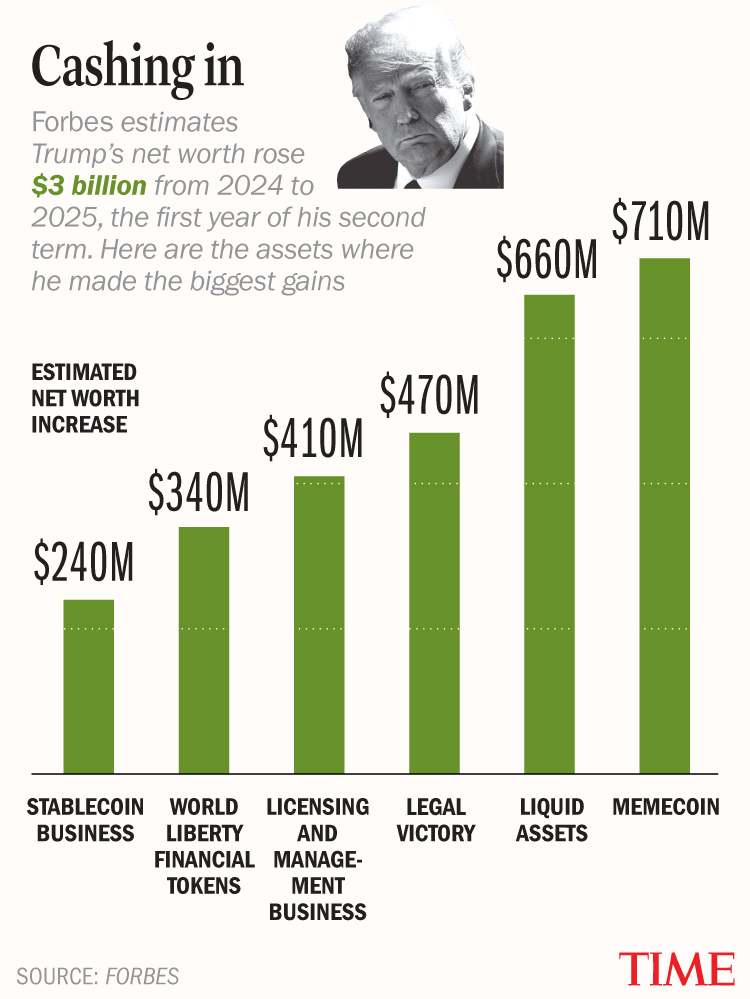
What has driven the increase in Trump’s net worth during his second term?Much of the growth in Trump’s net worth between 2024 and 2025 stemmed from dealings in the cryptocurrency industry, according to Forbes’ reporting last year, including an increase of about $710 million from memecoin, $240 million from stablecoin—a type of cryptocurrency that has a value that is linked to a fiat currency or another asset— and $340 million from tokens sold by the Trump family’s crypto business, World Liberty Financial.
 —Drew Angerer/Getty Images
Trump announced the creation of World Liberty Financial in September 2024, weeks before he won re-election. The New York Times reported that the President "effectively controls a stake" in the business, but that his sons, along with U.S. envoy Steve Witkoff’s family, manage its operations. World Liberty Financial started selling its $WLFI tokens in October 2024, and unveiled a stablecoin linked to the value of the U.S. dollar, USD1, the following March.
Shortly before Trump was inaugurated for a second term, he also separately unveiled a memecoin called $TRUMP; a few days later, his wife launched one called $MELANIA.
Trump’s annual financial disclosure for 2025 revealed that he earned over $1 billion that year as a result of his family’s cryptocurrency dealings.
As of 2026, Forbes reported in September, Trump’s memecoin tokens accounted for about $183 million of his roughly $7 billion net worth, while World Liberty Financial tokens accounted for about $78 million and Stablecoin for about $233 million.
His liquid assets—meaning cash or other assets that can be rapidly converted into cash—made up another $1.9 billion of his total net worth, according to Forbes, which attributed part of that figure to hundreds of millions of dollars that stemmed from cryptocurrency sales. Forbes previously reported in 2025 that the value of the President’s liquid assets grew by about $660 million during his first year back in the White House.
Read More: 3 Ways Trump’s Wealth Has Soared Since He Returned to Office
Trump’s licensing and management business, meanwhile, added about $410 million to his net worth between 2024 and 2025, according to the outlet.
Forbes attributed part of the growth in the President’s net worth related to his licensing and management business to international real estate deals, including in Saudi Arabia and the United Arab Emirates. TIME has also previously reported on licensing deals that the President unveiled shortly before his second inauguration, including selling items such as Bibles and fragrances.
Trump’s licensing and management business accounted for about $655 million of his total net worth as of 2026, according to Forbes’ tally from September. The news outlet reported that his golf clubs and resorts accounted for another $1.8 billion of his total net worth, and his real estate investments for $1.1 billion.
Also contributing to the President’s rising net worth in his first year back in the White House was a legal victory: appellate judges in 2025 tossed out a fraud penalty that a previous court ruling had levied against Trump, boosting his net worth by about $470 million, according to Forbes’ reporting from last year.
How does Trump’s handling of his finances differ from other Presidents?According to Payne, past Presidents have typically tried “to avoid the appearance of conflicts of interest and the appearance that they are using public office for private gain,” including by divesting their interests in businesses and placing their assets in what’s called a “blind trust,” an arrangement in which another individual is tasked with managing the assets and the trustor—as well as the beneficiaries—are not informed of the details. This arrangement is often used by politicians to avoid a possible conflict of interest or the appearance of a conflict.
Trump’s assets, as well as his business interests and investments, are in a type of trust, but it is not a blind one, the Times has reported. Trump has said that two of his sons, Eric Trump and Donald Trump Jr., manage the family business.
Payne says that this, and “the large amount of money that [Trump] has made in just one year in office” has raised concerns and sparked conflict of interest allegations.
Among the actions that have given rise to such allegations, the federal government has made moves during Trump’s second term to embrace the crypto industry.
In February 2025—about a month after Trump was sworn into office for his second term—the U.S. Securities and Exchange Commission’s Division of Corporation Finance announced that “It is the Division’s view that transactions in the types of meme coins described in this statement, do not involve the offer and sale of securities under the federal securities laws,” meaning that its view is that memecoins do not need to be subjected to the same oversight and regulation as a security.
A few months later, Trump signed the GENIUS Act into law, which the White House said would help protect “consumers from nefarious actors in financial markets” and aims to promote the use of stablecoins in the country. The White House said on its website that the “legislation creates the first-ever Federal regulatory system for stablecoins, ensuring their stability and trust through strong reserve requirements.”
“It just comes down to the fact that the President’s policies are very favorable to the same industry where he is heavily invested,” Payne says.
The White House has denied that Trump’s cryptocurrency-related assets present any conflict of interest. In a statement to media outlets in July, White House spokesperson Anna Kelly praised Trump for making the U.S. “the crypto capital of the world” while insisting that “neither the President nor his family has ever engaged—or will ever engage—in conflicts of interest.”
When Douthat asked the President how his net worth increased following the 2024 election, Trump said, “I devote almost no time to my net worth.” He went on to say that his son “watches over money.”
“I don’t even talk to him about it,” Trump said. “He watches. He gives—they gave my money, I have a lotta cash, had a lotta cash long before I came in here.”
Categories: ENTERTAINMENT RSS Streams
Thune reelected as Senate GOP leader after brutal midterm losses - CBS News
- Thune reelected as Senate GOP leader after brutal midterm losses CBS News
- GOP senator withholds support for Thune as leadership showdown looms Fox News
- Thune and Schumer face questions about Senate leadership in aftermath of elections AP News
- Pressure builds on Thune ahead of GOP leadership elections Axios
- Live updates: Senate GOP elects John Thune as leader; House GOP picks Jim Jordan The Hill
Categories: ENTERTAINMENT RSS Streams
US charges 3 men with plotting terror attacks, including planned assault on UK airbase - AP News
- US charges 3 men with plotting terror attacks, including planned assault on UK airbase AP News
- Iranian operative used coded messages on NY jail call to direct failed UK terror plot CNN
- Iran-backed terror suspects plotted attack on US troops using vans packed with fuel, DOJ says Fox News
- Failed Plot to Attack U.K. Was Directed From New York Jail, U.S. Says The New York Times
- 3 charged with plotting terror attacks in U.S., Europe Axios
Categories: ENTERTAINMENT RSS Streams
Chiefs agree to trade for WR Josh Downs - NBC Sports
- Chiefs agree to trade for WR Josh Downs NBC Sports
- Chiefs snag needed help at WR, trade for Colts' Josh Downs ESPN
- NFL Network: Chiefs acquire Colts WR Josh Downs ahead of trade deadline NFL.com
- Patrick Mahomes makes his feelings known on Chiefs' Josh Downs trade move Yahoo Sports
- Chiefs strike at trade deadline for WR as Colts continue fire sale USA Today
Categories: ENTERTAINMENT RSS Streams
Cruise ship murder suspect makes first federal court appearance in Galveston - KHOU
- Cruise ship murder suspect makes first federal court appearance in Galveston KHOU
- FBI: Tyler man accused of killing wife on cruise KLTV.com
- Child found in cabin where East Texas man allegedly killed wife on cruise ship out of Galveston Click2Houston
- Texas man charged with murder onboard MSC cruise ship, said he 'snapped' during dispute FOX 26 Houston
- Man charged with murder on cruise says he ‘snapped’ and choked wife, complaint says NBC News
Categories: ENTERTAINMENT RSS Streams
Short seller flagged Jensen Huang’s 'uncomfortably close' ties to alleged Chinese spy months ago - Fox Business
- Short seller flagged Jensen Huang’s 'uncomfortably close' ties to alleged Chinese spy months ago Fox Business
- Who Is Alice Huang, the Woman in the Middle of Nvidia’s Spy Scandal? The New York Times
- Nvidia's Huang tries to project 'business as usual' in return to office after affair revelation CNBC
- Massachusetts State Police to pay Karen Read $100,000 settlement The Washington Post
- Nvidia heads for $470 billion two-day wipeout as CEO affair fallout deepens Reuters
Categories: ENTERTAINMENT RSS Streams
Bernie Sanders says he won't support Schumer as Democratic leader in new Congress - CBS News
- Bernie Sanders says he won't support Schumer as Democratic leader in new Congress CBS News
- Bernie Sanders says he will not back Schumer for Senate Democratic leader The Guardian
- Bernie Sanders won't support Schumer for Senate Democratic leader, saying it's time for change 10TV
- Van Hollen calls colleagues as Schumer’s leadership faces questions MS NOW
- Machinists union calls on Schumer to step aside as leader Politico
Categories: ENTERTAINMENT RSS Streams
US federal authorities could have prevented Epstein crimes, report finds - BBC
- US federal authorities could have prevented Epstein crimes, report finds BBC
- Outgoing Republican chairman to DOJ and Democrats: Keep investigating Jeffrey Epstein CNN
- Federal government failed to hold Epstein accountable, Republican committee says NPR
- Explosive House report exposes failures it says allowed Epstein's abuse to continue for years Fox News
- House Oversight Republicans release final report on Epstein investigation Politico
Categories: ENTERTAINMENT RSS Streams
Stock Market Today: Yields Jump as Inflation Comes in Hotter Than Expected — Live Updates - WSJ
- Stock Market Today: Yields Jump as Inflation Comes in Hotter Than Expected — Live Updates WSJ
- Here's the inflation breakdown for October 2026 — in one chart CNBC
- Hot CPI Pushes 10-Year Yield to 5%, Nvidia Sinks: Stock Market Today - Microsoft (NASDAQ:MSFT) Benzinga
- Bonds Tumble as Hot Inflation Fuels Bets on More Fed Rate Hikes Bloomberg.com
- Broad Price Pressures Firm Up Case for Fed Rate Increase in December WSJ
Categories: ENTERTAINMENT RSS Streams
‘Brilliant fireballs:’ meteors to shoot across Idaho night sky. Here’s when to watch - East Idaho News
- ‘Brilliant fireballs:’ meteors to shoot across Idaho night sky. Here’s when to watch East Idaho News
- Meteor shower may bring ‘incredible fireballs.’ When to watch in Illinois Belleville News-Democrat
- Taurid meteor shower 2026: When to see fireballs in November The Weather Channel
- The Taurid meteor shower could bring bright, slow-moving shooting stars this week. Here's how to watch. 9NEWS
- Look up tonight! Northern Taurid fireballs could streak across the night sky USA TODAY 10BEST
Categories: ENTERTAINMENT RSS Streams
Sanders, Slotkin won’t back Schumer as Senate Democratic leader - The Hill
- Sanders, Slotkin won’t back Schumer as Senate Democratic leader The Hill
- Bernie Sanders Opposes Schumer as Majority Leader The New York Times
- Bernie Sanders says he will not back Schumer for Senate Democratic leader The Guardian
- Van Hollen calls colleagues as Schumer’s leadership faces questions MS NOW
- Sanders won't back Schumer as Democratic leader in new Congress Yahoo
Categories: ENTERTAINMENT RSS Streams
Sanders, Slotkin won’t back Schumer as Senate Democratic leader - The Hill
- Sanders, Slotkin won’t back Schumer as Senate Democratic leader The Hill
- Sanders says he won’t support Schumer as majority leader Politico
- Bernie Sanders won't support Schumer for Senate Democratic leader, saying it's time for change AP News
- Bernie Sanders says he won't support Schumer as Democratic leader in new Congress CBS News
- Schumer Faces Pressure to Step Aside as Chris Van Hollen Hints at Run for Senate Majority Leader Democracy Now!
Categories: ENTERTAINMENT RSS Streams
Report: Despite multiple offers, Colts will not trade Jonathan Taylor - NBC Sports
- Report: Despite multiple offers, Colts will not trade Jonathan Taylor NBC Sports
- Jonathan Taylor says he appreciates Colts fans after possibly playing his last game for Indianapolis Yahoo Sports
- Jonathan Taylor Won't Be Traded by Colts Despite 'Multiple Offers,' New NFL Rumors Reveal Bleacher Report
- John Harbaugh: Giants did pull offer for Jonathan Taylor but 'things do change' ESPN
- Jonathan Taylor offers emotional goodbye to Indy after final game before trade deadline IndyStar
Categories: ENTERTAINMENT RSS Streams
David Walliams accused of sexual misconduct after losing injunction bid
ITN and the Guardian allege the comedian preyed on teenage girls and young women. He has denied all allegations.
Categories: ENTERTAINMENT RSS Streams
David Walliams accused of sexual misconduct after losing injunction bid
ITN and the Guardian allege the comedian preyed on teenage girls and young women. He has denied all allegations.
Categories: ENTERTAINMENT RSS Streams
‘I don’t like the prospect of losing’: Supreme Court visa fine argument leaves DOJ worried - The Hill
- ‘I don’t like the prospect of losing’: Supreme Court visa fine argument leaves DOJ worried The Hill
- Supreme Court seems split over federal agencies' ability to fine for law violations NPR
- Supreme Court grapples with arguments over federal agencies’ power to impose fines The Washington Post
- Whose tradition, which history? Agency adjudication and Sun Valley Orchards SCOTUSblog
- US Supreme Court weighs limits of federal agency powers in farmworker rights case Reuters
Categories: ENTERTAINMENT RSS Streams
Missouri's Eli Drinkwitz questions need for conferences in 24-team CFP era - ESPN
- Missouri's Eli Drinkwitz questions need for conferences in 24-team CFP era ESPN
- What a 24-team College Football Playoff would look like this week: LSU would visit Texas Tech, and Ohio State would go to Wake Forest Yahoo Sports
- What does SEC Championship Game ending mean for Atlanta’s economy? WSB-TV
- Lanning: Talent spread fuels support for bigger playoff OregonLive.com
- 24-team College Football Playoff bracket seeded based on second 2026 CFP Rankings On3
Categories: ENTERTAINMENT RSS Streams
Nvidia hires major New York law firm to investigate Huang affair - BBC
- Nvidia hires major New York law firm to investigate Huang affair BBC
- Who Is Alice Huang, the Woman in the Middle of Nvidia’s Spy Scandal? The New York Times
- Nvidia hired Wachtell Lipton to lead probe of Jensen Huang's affair with suspected Chinese spy Quartz
- Nvidia stock drops 6%, extending decline on report alleged Chinese spy linked to Nvidia CEO aided $7.5 billion in China chip shipments Yahoo Finance
- China panel chair Moolenaar demands answers on Nvidia CEO's alleged affair with a Chinese spy CNBC
Categories: ENTERTAINMENT RSS Streams