

ENTERTAINMENT RSS Streams
Police assess new reports against Russell Brand after his rape conviction - NBC News
- Police assess new reports against Russell Brand after his rape conviction NBC News
- British comedian Russell Brand sentenced to over 10 years for rape and sexual assault NPR
- Russell Brand Found Guilty of Rape, Sexual Assault in London Court Yahoo
- Producer Jemima Goldsmith Accuses Russell Brand Of “Violence, Coercive Control & Abuse” Deadline
- Megyn Kelly expresses ‘outrage’ over convicted rapist Russell Brand’s ‘insane’ 10-year prison sentence Page Six
Categories: ENTERTAINMENT RSS Streams
Europe and US agree to review postwar continental security as Ukraine talks begin - POLITICO.eu
- Europe and US agree to review postwar continental security as Ukraine talks begin POLITICO.eu
- Russia, Ukraine and US meet for Abu Dhabi talks as Trump says war can 'end soon' ABC News - Breaking News, Latest News and Videos
- Why U.S. Business Deals Are Unlikely to Get Putin to Give Any Ground The New York Times
- U.S. Overture to Russia on European Security Sparks Alarm WSJ
- Russia and Ukraine hold nearly 4 hours of U.S.-mediated talks in Abu Dhabi Los Angeles Times
Categories: ENTERTAINMENT RSS Streams
Here's why North Texas is experiencing an earlier flu season - Dallas News
- Here's why North Texas is experiencing an earlier flu season Dallas News
- The flu strain driving this season's unusually early spread USA Today
- Does an early flu season mean a bad flu season? NBC News
- Flu’s early surge sends ED visits up 42% in 1 week: 6 notes for clinical leaders Becker's Hospital Review
- Flu season hits New York earlier than ever, with influenza A dominating cases Yahoo
Categories: ENTERTAINMENT RSS Streams
Review: Apple’s M6 MacBook Pro is good, but it’s missing all the exciting stuff - Ars Technica
- Review: Apple’s M6 MacBook Pro is good, but it’s missing all the exciting stuff Ars Technica
- Apple MacBook Pro review: lighter, thinner and a stunning OLED touchscreen The Guardian
- The touchscreen MacBook Pro is a winner The Verge
- Can the Touchscreen MacBook Pro Replace an iPad Pro M5? What You Give Up TechRepublic
- Apple's first deliveries offer a closer look at new iPad mini, MacBook Pros, and iMac AppleInsider
Categories: ENTERTAINMENT RSS Streams
NASA is paying $164,000 for people to live on the Moon - Yahoo Tech
- NASA is paying $164,000 for people to live on the Moon Yahoo Tech
- NASA needs more astronauts for moon missions and beyond. You can apply now, but only until Dec. 3 Space
- NASA Seeks Next Generation of Explorers to Join Astronaut Corps NASA (.gov)
- Want to fly to the moon? NASA is looking for new astronauts to help grow its Artemis program ABC News - Breaking News, Latest News and Videos
- Want to be a NASA astronaut? Here's what the job pays Detroit Free Press
Categories: ENTERTAINMENT RSS Streams
Inside the Troubling Rise of TeleICUs
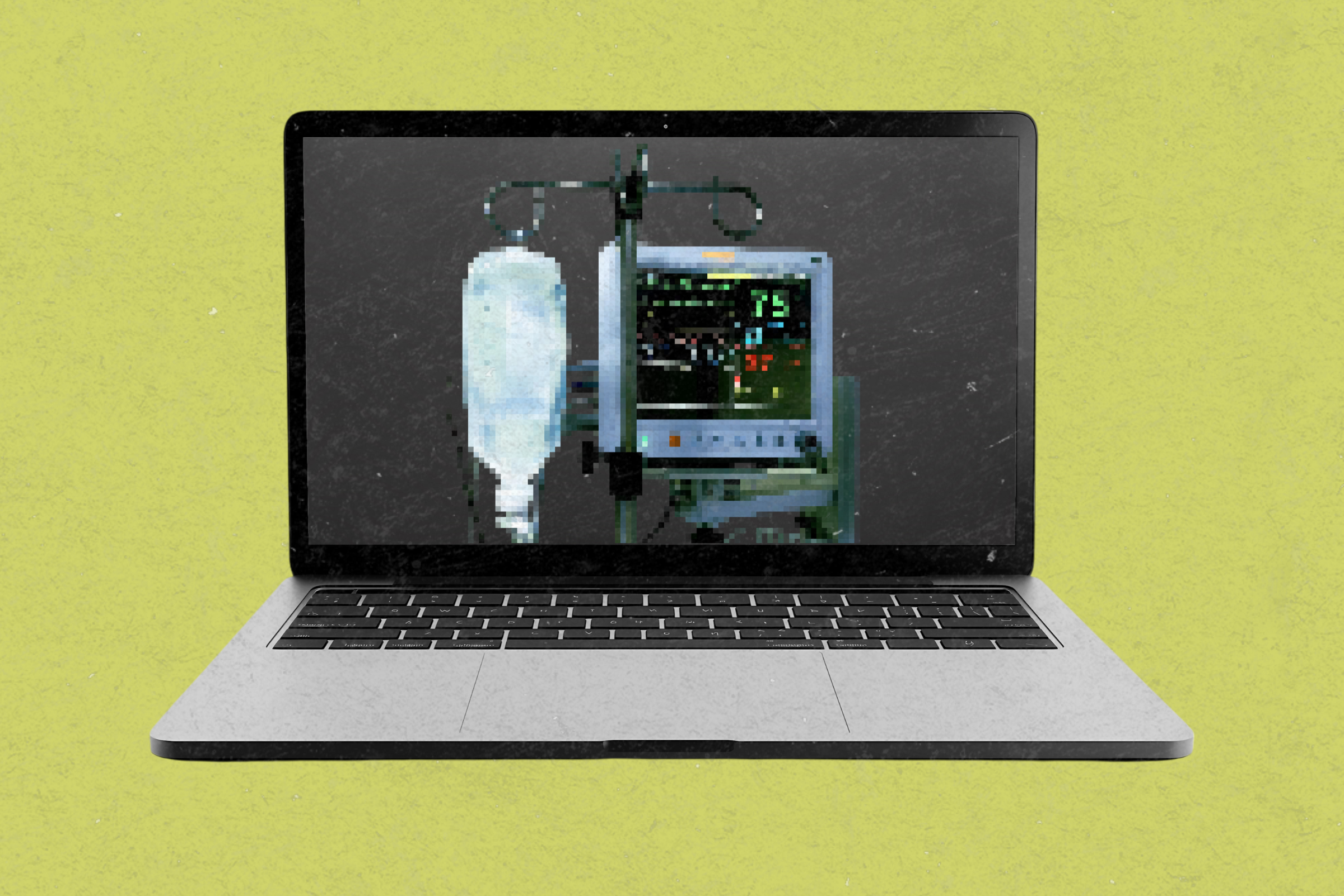 —Photo-Illustration by TIME (Source Images: Pexels, Arafat Uddin via Canva)
It was the middle of the night in the intensive care unit (ICU) of Island Hospital in Anacortes, Wash., and a patient was hallucinating and in withdrawal from alcohol. The Ativan he’d been given wasn’t enough to lower his heart rate, and Joyce Selph, a longtime nurse, was called over to assist.
The protocol, she knew, was to call the attending physician and figure out next steps, but there was a problem. The hospital used a teleICU model, in which doctors staffed the ICU during the day, but only remote doctors were available overnight, via computer screen. Selph and the other nurses had tried to reach the teleICU doctor, but no one answered the calls.
There was no one else to ask, and the patient was rapidly deteriorating. So Selph, who had been a nurse for more than 30 years, did what she assumed a doctor would do; she started the patient on Precedex, a medication that can help sedate a patient.
Giving medication without a doctor’s orders risked her license, Selph knew, but not doing anything risked the patient’s life. The patient survived. Selph was so disturbed by the incident that she complained to her nursing supervisors and to the hospital’s administration that having a doctor on screen rather than in person was bad policy, but they decided to keep it for financial reasons, she says.
Soon after, Selph quit her job at Island Hospital, she says, because she felt that the teleICU was endangering patients’ safety and making her practice outside of her scope.
“They did it as a cost-saving measure because they were having trouble getting hospitalists to want to be there,” Selph says. “But I felt very strongly that it was unsafe.” (Island Health said, in a statement to TIME, that it launched a teleICU program in 2021 to strengthen the level of critical care available in its rural community. It has used a vendor to run the program, the spokeswoman said, and “any technical challenges that have arisen have been addressed directly with [the vendor] to ensure continued safe, effective patient care.”)
More hospitals are implementing teleICUs, especially overnight, as they struggle to recruit enough providers while keeping costs low. Having a remote physician who can staff multiple hospital ICUs at once can keep ICUs open and revenue coming in, even in the midst of an ongoing shortage of doctors. Though the model was initially pitched as a way to help rural systems deploy experts at all hours, it is frequently used in more urban and suburban areas as well. One 2025 paper surveyed 574 adult ICUs across the country and found that about one third implemented some form of telemedicine.
The teleICU model has been gaining attention recently after Conor Hylton, a 26-year-old dental student, died in 2024 after being transferred to an teleICU at the Milford Campus of Bridgeport Hospital in Connecticut, part of Yale New Haven Health. In March 2026, his family filed a lawsuit over his treatment. The complaint included an inspection report from the Centers from Medicare and Medicaid Services (CMS) that found, among other failures, that no physician had overseen Hylton’s care after he was transferred to the ICU, and that the ER physician who had been called up to intubate him did not know the way to the ICU and got lost, delaying Hylton’s treatment by crucial minutes.
William Hylton, Conor’s father, told TIME about the experience of watching his son die as a doctor on a big screen tried to give nurses instructions to adjust his ventilator. He’d brought his son to the emergency room with stomach pain the night before and was told he’d be hydrated inpatient and released shortly after. Conor was transferred to the ICU after William had left for the evening, because his pancreas was inflamed and his heart was racing. The hospital violated its own policy by not informing Conor’s parents that he had been transferred, the CMS report found. His parents got a call at 4:30 a.m. alerting them that their son was near death and in the eICU; they raced to the hospital where they watched their son die, 11 hours after he had arrived at the hospital. “I started thinking about the guy in the screen, and thinking, ‘What the hell was that?’” Hylton says. “Why wasn’t there someone at his bedside?”
The hospital in Connecticut isn’t the only teleICU where patient care appears to have suffered because of the remote setup. TIME reviewed hospital inspection reports from the last six years by the Centers for Medicare and Medicaid Services and found three other instances in which patients died or received substandard care after interacting with a teleICU doctor. In one 2024 instance in Los Banos, Calif., a teleICU physician ordered a medication for a patient whose heart rate was rapidly dropping, “but the record did not indicate it was administered,” the inspection says, and the patient died. In 2021 at a medical center in Reading, Penn., a teleICU physician ordered that a patient with COVID be intubated, but no in-person doctor capable of inserting a chest tube was available for two hours; the patient coded while the chest tube was finally being inserted. And at a hospital in Louisiana, a critically ill patient could not be transferred to another facility for care because hospital staff “failed to follow the appropriate process for after-hours when there was no in-house physician on call.” They did not know they were supposed to call the teleICU doctor, and the patient died while waiting to be transferred.
Experts say that while teleICUs can be useful in providing care, many hospitals don’t use them effectively and instead use them primarily to cut costs. “It can definitely be misused if the goal is to make the spreadsheet look good and staff as many beds as possible with one doctor,” says Dr. Eric Scholten, who works as an teleICU doctor in a system in the American West where he says the system functions well. (His hospital did not give him permission to speak on its behalf.)
Selph says that nurses are often the ones who have to take on the duties of examining a patient and assessing them in person because a teleICU doctor can’t. That seems wrong to her. “These patients are being charged for care, thinking they are getting a physician monitoring their case,” she says. “But in reality they weren’t even assessing the patients themselves; it was the nurse assessing and giving information.”
It’s an open secret among many doctors and nurses that some hospitals with teleICUs provide poor quality care. One doctor whose practice contracts with a teleICU in North Carolina and provides services there—who wished to remain anonymous—told TIME that none of the doctors in his practice send their families to the hospital where the teleICU is used because they all think it’s sub-standard care. “The running joke is, ‘Don’t send me to that hospital if I’m sick,’” he says.
The rise of the teleICUTeleICUs first became popular in the mid-2000s after research suggested that patients in ICUs would benefit from having what’s called an “intensivist,” an expert in treating ICU patients, available 24-7, says Deena Costa, a professor at the Yale School of Nursing who has studied teleICUs. At the time, many hospitals didn’t have intensivists available overnight.
A company called Visicu, founded in 1998 by two intensivists at Johns Hopkins Hospital, became the leading company to provide this teleICU technology, advertising that it could cut costs by 25% while making an intensivist available around the clock and reducing the number of ICU deaths: a win-win-win.
Costa, who was an ICU nurse before going into academia, says she remembers the buzz around the Visicu system at the time, but that nurses she interviewed had mixed feelings about its effectiveness. Some told her they felt micromanaged and surveilled. Since then, some studies have suggested that the round-the-clock presence of an intensivist isn’t as essential as researchers once thought because it doesn’t have an impact on mortality, she says.
But many hospitals had already embraced the teleICU system, and for some, there was no going back. By 2016, Philips, which had acquired Visicu in 2008, was touting the financial benefits of teleICUs, citing a study that found that they increased case volume by 44% and helped save hospitals tens of millions of dollars by reducing the need for doctors on the premises.
ICUs on their own don’t generally bring in a lot of revenue for hospitals, says Dr. Nandita Nadig, an associate professor at Northwestern University’s Feinberg School of Medicine and a critical care doctor. But some hospitals that have other specialties that may bring in revenue, like a stroke center or a surgeon who performs bypass surgery, are required to have ICUs if they want to have those specialties, she says.
By 2018, about 18% of total ICU beds in the U.S. used telemedicine critical care, up from less than 5% in 2010, one study found.
Then came the pandemic. As ICUs became filled with critically ill people and hospitals faced a shortage of critical care doctors, more facilities adopted the technology.
By October 2020, Philips said it was seeing “increased interest in telehealth solutions like Tele-ICU.”
The benefits of teleICUsFor hospitals, the big benefit of a teleICU is that it can provide the perspective of a critical care doctor without having to pay for one to be at your facility at all hours. This is especially beneficial for rural hospitals that can’t afford to staff a critical care specialist around the clock, or for a larger health system where one virtual specialist can check in on patients at multiple hospitals.
“The reality is that not every place is desirable to raise a family or build a life, so you do need some of this backstop—I do believe there’s a place for it,” says Dr. Allison Harriott, a critical care and emergency medicine physician who has researched teleICUs. “But can it fully supplant what I do at the bedside? I don’t think so.”
Having a remote intensivist available to lend expertise can be useful for patients in rural areas, says Nandig. Intensivists may see a red flag that a patient should be put on a heart-lung machine, for instance, or that they need a lung transplant. They can also help patients who are in small, local hospitals stay in their communities, she says, rather than be transferred hundreds of miles to a facility with an intensivist.
The U.S. has a shortage of intensivists, Nandig says, and as patients get older and their care becomes more complex, teleICU doctors can be better than not having any intensivist available.
One 2025 study funded by Philips found that from 2012 to 2020, hospitals with telecritical care capabilities had lower patient death rates in the ICU and shorter ICU stays. Philips customers use the technology “to extend access to intensivist expertise, support bedside clinicians, monitor patient populations and help identify patients who may need earlier intervention,” says Martijn Hartjes, an executive at Philips who leads hospital patient monitoring.
But both Hartjes and Nandig agree: a teleICU doctor should not replace bedside physicians. “The value of a teleICU is really how well it’s applied,” says Nandig. Hartjes echoed this sentiment. “The Philips eICU program,” he says, “is intended to supplement, not replace, bedside care.”
Problems with implementationThe original purpose of teleICUs seems to have been lost in recent years, Nandig says. A 2021 study found that teleICUs were actually less predominant in rural hospitals than in urban and suburban hospitals.
Recent estimates suggest that about one fifth of hospitals in the country use teleICUs. Now, as more hospitals struggle financially in response to funding cuts in legislation like H.R. 1—the One Big Beautiful Bill Act—and impending cuts to Medicaid, some are considering switching to teleICUs. In 2025, the Milwaukee Journal Sentinel reported that Ascension, a nonprofit chain of Wisconsin hospitals, was replacing some of its critical care doctors with physicians from a national staffing agency, including telehealth doctors. (Ascension said in a statement that it had incorporated telehealth capabilities “as a supplement to our providers and care teams, a model used broadly around the world.”) A Montana-based medical center told NBC in June 2026 that it planned to transition its pediatric intensive care services to a 24/7 telehealth-supported model, despite pushback from physicians and nurses.
TeleICUs operate very differently in the U.S. than they do in other countries, says Dr. Claudia Spies, medical director of Charite Universitatsmedizin Berlin, a teaching hospital that has a teleICU. Spies, who has researched teleICUs, says that in Germany and other high-income countries, the teleICU exists to give patients access to more specialists who can weigh in on their case. But this complements in-person care; hospitals with teleICUs do not typically cut staff, she says. Instead, there is still a doctor physically present in the teleICU, who consults with the other doctors over the screen to decide how best to treat the patient.
“Here, it was never really used to save money on staff,” Spies says. “In my opinion, that’s not the way an ICU should be established.” Public health insurance in Germany won’t reimburse treatment in the ICU if there is not a doctor physically present, she says.
In Brazil, teleICUs expanded during the COVID pandemic, but were primarily used to train physicians and nurses in responding to critically ill patients, rather than replacing in-person health care. The program stayed in place after the pandemic in many hospitals that did not have intensivists on site.
Scholten, the doctor who works at an teleICU in the U.S., says that the system can work well—even without a doctor physically present in the ICU—if the virtual doctor is familiar with the hospital system and the doctors who work there. The doctor needs to intimately understand the processes of how the hospital works, like who to contact to get a patient intubated or discharged. His hospitals have flow sheets that tell nurses what to do if someone is deteriorating rapidly and there’s no cardiac surgeon nearby, for instance. Outsourcing the teleICU to third-party contractors is generally not a good model, he says. “It takes a lot of resources to make it work well,” he says, “as a service to keep people in their local community.”
In his experience, teleICUs have been helpful at getting patients off of ventilators earlier than they would have been able to if they’d had to wait for a doctor to round, he says, which cuts down on infection risk. For routine pneumonia or routine heart failure, teleICUs can help local doctors more effectively manage patients, he says.
But teleICUs shouldn’t be thought of as a way to save money, he says—because oftentimes, they don’t. “I would argue that it’s cost-neutral,” he says. “It provides high-quality care to rural sites and allows you to efficiently care for patients.”
“It can go awry when they just say, ‘We’re getting rid of bedside coverage, and you just call this person who’s a long way away and doesn’t know the culture,” Scholten says.
Unfamiliar territoryThe problem of a teleICU doctor being unfamiliar with the inner workings of a hospital came up repeatedly in the public records searched by TIME. Many times, hospitals with problematic teleICUs did not have a clear process for communication between virtual doctors and inpatient doctors. In other instances, patients and their families were not told why the patient was being seen by a teleICU doctor rather than a bedside doctor.
After Conor Hylton died, CMS investigated Bridgeport Hospital’s Milford Campus and found that “the hospital failed to ensure quality medical care was provided to a patient who presented to the Emergency Department and was transferred to the intensive care unit.” Among other things, the investigation found that the hospital did not integrate the teleICU well into the rest of the system: there was no process for the in-person emergency room doctor to sign out to the teleICU doctor, for instance. And when Hylton went into cardiac arrest at 4:33 a.m., the only doctor who could intubate him—the emergency room doctor—did not arrive until 4:45 a.m. because the doctor did not know how to get to the ICU: proof, his family’s lawyer argues, of a system that did not plan adequately for emergencies. The nurses, teleICU doctor, and hospitalist were all unsure who was supposed to lead the code in the ICU when Hylton went into distress, according to the report. Yale New Haven Health said in a statement to TIME that “our priority has always been, and remains, providing safe, high-quality care to our patients. We remain committed to continuous review and improvement of patient safety practices. Because this is active litigation, we cannot comment on specific allegations and will address the claims in the appropriate legal forum.”
Similarly, in 2024, CMS investigated Memorial Hospital Los Banos in California after the teleICU doctor ordered a critical medication for a patient that may not have been administered, and the patient died. The report found no record of the in-house physician being notified of the patient’s condition, and no record of any doctor—virtual or not—proclaiming the patient dead. CMS determined that the hospital and the outside teleICU company it contracted with did not appropriately coordinate care. Medical directors of the teleICU and the hospital were supposed to be meeting quarterly to improve care in the teleICU, but they did not, according to the report. Sutter Health said, in a statement, that “we consistently take opportunities to reexamine and reevaluate policies and clinical workflows within all our care settings so as to enhance our abilities to care for our patients,” but that legal requirements prevented the hospital from providing additional information.
The lack of a clear chain of command between doctors in the hospital and the one in the teleICU came up frequently in CMS investigations into incidents involving this type of care. In Glenwood Regional Medical Center in West Monroe, Louisiana, an ICU patient was awaiting transfer to another hospital, but one doctor did not answer their phone, and staff failed to notify any other medical provider—including those in the teleICU, who were on call from 7 p.m. to 7 a.m. The teleICU was called later that night when the patient was in severe distress, according to the CMS report, and soon after, the patient died. The hospital’s chief medical officer later said in interviews with CMS that staff should have called the teleICU for the transfer, but the inspection report found that staff weren’t trained on who to contact. (Healthcare Systems of America, which owns Glenwood Regional Medical Center, did not respond to a request for comment.)
The absence of in-person staff to treat patients who need immediate care also came up repeatedly in CMS investigations involving teleICUs. At Penn State Health St. Joseph Medical Center, a patient’s lung collapsed and a virtual ICU physician ordered intubation and placement of a chest tube, but “the cardiothoracic physician failed to arrive in a timely manner,” and the patient coded when the chest tube was being inserted, according to the CMS investigation. The report found that there was no chain of command for staff to escalate the process when an in-person physician does not show up on time, the report found. Penn State Health did not respond to a request for comment.
William Hylton says that patients, like his son, have the right to know whether the hospital they’re going to has an teleICU, and whether there are nearby hospitals that may have more in-person resources available to help patients in distress.
“There was no doctor in person providing critical care,” he says. “You can’t insert a breathing tube through a television.”
He hopes that Connecticut and other states will pass laws that require hospitals to divulge whether they have teleICU and offer to transfer patients to other hospitals if they can’t handle the level of care that the patient needs.
It’s not just Connecticut where family members are seeking more transparency about teleICUs. In its investigation into the incident at Memorial Hospital Los Banos, CMS interviewers found that the family members of another patient who was in the same ICU had concerns about the teleICU. That patient’s son and daughter-in-law said that they did not like that the hospital did not have doctors present in the ICU and that patients were telemonitored. They had asked for their father to be transferred to a larger hospital with more resources, according to the inspection report, but he was not transferred. He also died in the hospital.
Joyce Selph, the nurse who was uncomfortable with how telehealth was administered at her hospital in Washington, now works at a hospital with in-person staff in the ICU, but she still thinks about the suffering that her patients had to go through because of the teleICU.
“We all know as nurses that stuff happens after hours,” she says. “But if there’s a time delay in getting care, for an ICU setting, that’s deadly.”
It bothers her that she told Island Hospital repeatedly about the problems in the teleICU and that nothing changed. She was the first to leave based on the changing model of care, she says, but since then, “there has been an exodus.” (A spokesperson for Island Health said its retention is in line with the national average and that its teleICU helps give care teams support so that patients aren’t automatically transferred to Seattle when Island Health can safely care for them near their homes.)
Selph says she remembers waiting as long as 30 or 45 minutes to hear back from a teleICU doctor at her old job when she needed to know how to handle a patient. In an ICU, time matters, she says, and a wait like that can change a patient’s trajectory. Even when the doctors did answer her calls, there was not a good system to communicate what was going on to the doctors on the screen, she says. “There’s a doctor who has never seen the patient before, has never assessed them—it’s like putting a blindfold on and trying to do medicine.”
She also believes that patients should know more about what kind of care they’ll be getting in an ICU before they check into a hospital. “The community has a right to know, if you’re going to come in and half of your care is going to be covered by a doctor who pops up on screen,” she says. “I wouldn’t take anybody I cared about to a hospital that used an eICU at night.”
Categories: ENTERTAINMENT RSS Streams
As Jaylen Brown faces the Celtics for the first time, familiar questions linger - ESPN
- As Jaylen Brown faces the Celtics for the first time, familiar questions linger ESPN
- What channel are Sixers on tonight? What time is Sixers vs. Celtics Yahoo Sports
- Jaylen Brown, Jayson Tatum Reportedly Had 'Heart-to-Heart' Talk in France Before Celtics-76ers Trade Bleacher Report
- Celtics visit 76ers in Jaylen Brown's first game against his former team since the offseason trade Fox News
- Payton Pritchard weighs in on Tatum and Brown’s ‘working relationship’ Boston.com
Categories: ENTERTAINMENT RSS Streams
Why heart attacks can still happen even when bad cholesterol is low - Science Daily
Categories: ENTERTAINMENT RSS Streams
Indonesia’s vice-president ‘intends to resign’ after qualifications questioned - Financial Times
Indonesia’s vice-president ‘intends to resign’ after qualifications questioned Financial TimesSee more headlines & perspectives on Google News
Categories: ENTERTAINMENT RSS Streams
Met Police investigate several reports on Russell Brand following his conviction
Det Supt Andy Furphy says the force had received "several reports in during the trial and since the trial".
Categories: ENTERTAINMENT RSS Streams
iPhone 20 Pro: Ten Big Changes That Could Redefine Apple's Flagship - MacRumors
- iPhone 20 Pro: Ten Big Changes That Could Redefine Apple's Flagship MacRumors
- Apple might get rid of longtime iPhone feature AL.com
- Next year’s iPhone Pro redesign will drop an important button, per leak 9to5Mac
- iPhone 20 range rumored to ditch Action Button AppleInsider
- Apple’s iPhone 20 Pro Models Rumoured to Retain Dynamic Island Deccan Chronicle
Categories: ENTERTAINMENT RSS Streams
Measles elimination decision brewing, where is the fall vaccination data, and good news you might have missed - Your Local Epidemiologist
- Measles elimination decision brewing, where is the fall vaccination data, and good news you might have missed Your Local Epidemiologist
- The U.S. Has Lost Its Measles-Elimination Status, Data Suggests The New York Times
- In America’s measles epidemic, RFK Jr. is now on trial Politico
- Measles Forges a Deadly Trail Across America, Exposing Fractured Health System Bloomberg.com
- Measles cases continue to rise across Ohio as experts urge vaccination NBC4 WCMH-TV
Categories: ENTERTAINMENT RSS Streams
GTA 6 Preloading Is Live. Here's How to Install the Game on PlayStation and Xbox - PCMag
- GTA 6 Preloading Is Live. Here's How to Install the Game on PlayStation and Xbox PCMag
- Xfinity Gives Gamers a Free 15-Day WiFi Speed Boost for the Highly Anticipated Grand Theft Auto VI Launch Comcast Corporation
- Download Grand Theft Auto VI Faster and Get to Leonida Sooner With Spectrum Internet Gig Charter Communications
- ‘GTA 6 Online’ Info Found In Pre-Loaded ‘GTA 6’ Files And Backend Forbes
- GTA 6's PlayStation Store Data Hints at Multiplayer Support TechPowerUp
Categories: ENTERTAINMENT RSS Streams
Why did California’s billionaire tax fail to surf the blue wave? : Planet Money - NPR
- Why did California’s billionaire tax fail to surf the blue wave? : Planet Money NPR
- California Voters Reject Prop. 40 Billionaire Tax Measure The New York Times
- California wealth tax on billionaires fails despite blue wave, in blow to progressives Fox Business
- California's Prop 40 'billionaires' tax' measure is rejected, AP projects ABC News - Breaking News, Latest News and Videos
- Billionaire tax measure on California ballot defeated Reuters
Categories: ENTERTAINMENT RSS Streams
First Call: A Steelers AFC rival makes big trades; a Jack Ham update; 2 Flyers have heated exchange on bench - TribLIVE.com
- First Call: A Steelers AFC rival makes big trades; a Jack Ham update; 2 Flyers have heated exchange on bench TribLIVE.com
- Jaguars acquire Eagles DT Jordan Davis in blockbuster trade ESPN
- Eagles news: ESPN calls Jordan Davis trade 'a disaster' for Jags; what's next for the Birds ahead of deadline? Inquirer.com
- The Jags get aggressive, plus new CFP details - The Athletic The New York Times
- How's Eagles Blockbuster Trade Impact Dallas Cowboys Playoff Plans? Yahoo Sports
Categories: ENTERTAINMENT RSS Streams
Republicans return to Washington to sift through wreckage of midterms rout - The Guardian
- Republicans return to Washington to sift through wreckage of midterms rout The Guardian
- Congress returns with government funding, Pete Hegseth and the debt limit on the agenda CNBC
- The Lame-Duck Choice: Shortcuts or Responsibility Cato Institute
- Congress returns to a changed Washington after GOP’s election wipeout AP News
- Congress returns for crowded lame-duck session as Hegseth impeachment, government funding deadline loom ABC News - Breaking News, Latest News and Videos
Categories: ENTERTAINMENT RSS Streams
Seagate’s FireCuda Forge moves your data between a hard drive and SSD for better performance - The Verge
- Seagate’s FireCuda Forge moves your data between a hard drive and SSD for better performance The Verge
- Seagate’s new hybrid drive raises some old questions Ars Technica
- Seagate resurrects hybrid storage: Hands-on with the FireCuda Forge – 8 or 20TB external hard drive requires you to bring your own NVMe SSD Tom's Hardware
- Seagate Launches the FireCuda Forge Powered by the New Alkemi Intelligent Platform TechPowerUp
- Seagate wants to turbocharge the hard drive, with a big, pricy catch PCWorld
Categories: ENTERTAINMENT RSS Streams
Sarah Ferguson in touch with ex-Prince Andrew as expert warns royal downfall 'has further to go' after arrest
Andrew Mountbatten-Windsor may have lost his royal titles, but the scandal surrounding his ties to Jeffrey Epstein continues to follow him — and his ex-wife, Sarah Ferguson.
People magazine reported that while it's unclear whether the former Duchess of York has seen her ex-husband recently, the two remain in contact.
"They have an ongoing cordial and supportive relationship as co-parents and co-grandparents," a spokesperson for Ferguson told People.
Fox News Digital reached out to Ferguson's spokesperson for comment.
"It is not surprising," royal commentator Richard Fitzwilliams told Fox News Digital. "If Andrew came to court, she might well be called as a witness. Much depends on whether the police in Britain can obtain the unredacted Epstein files. But there is no way back for Andrew. He hasn't helped the FBI. He has no support. He has no reputation to lose. It can't get much worse. His fall is unique. It has further to go."
Andrew has been issued a witness summons in a civil fraud case, marking what is believed to be the first such summons issued to a member of the British royal family since 1870, The Associated Press reported.
WATCH: SARAH FERGUSON DENIES TELL-ALL BOOK AMID ROYAL FAMILY CONCERNS: EXPERT
The summons comes after a High Court judge in London ruled in October that Andrew could be called to testify about a payment he received in connection with the case. Andrew may apply to have the summons set aside, so there is no guarantee he will testify, the AP reported.
The lawsuit was filed by Turkish national Nebahat Evyap Isbilen, who alleges that her former advisor, Selman Turk, misappropriated tens of millions of pounds of her money. As part of the case, she says Turk misled her about a 750,000-pound (approximately $1 million) payment he arranged for her to make to Andrew in 2019. The younger brother of King Charles III repaid the money in 2021, and he is not a party to the lawsuit. Turk denies dishonesty.
Police Scotland confirmed to People that "active inquiries" are underway into information concerning Andrew and Epstein at Balmoral Castle, the royal family's Scottish estate. Police told People that the inquiries are at a "very early stage."
The confirmation follows a report by the Scottish Daily Express that police inquiries concern allegations that women were trafficked to the royal estate, where Andrew hosted Epstein and his longtime associate, Ghislaine Maxwell.
"All inquiries are evidence led, with the needs of victim survivors at the heart of those enquiries," Police Scotland told People. "We would never confirm details of ongoing enquiries, and it would be inappropriate to comment further."
Police declined to specify the focus of the inquiries or whether Andrew is the subject of an investigation. Fox News Digital reached out to Police Scotland and Andrew's attorney for comment. A spokesperson for Buckingham Palace told Fox News Digital the palace does not speak on Andrew's behalf because he is no longer a working royal.
GET ENTERTAINMENT SCOOP DELIVERED RIGHT TO YOUR EMAIL BY CLICKING HERE
Andrew lives in seclusion on the king’s Sandringham estate in Norfolk. A spokesperson for Ferguson told People that she has been spending time with their daughters, Princess Beatrice and Princess Eugenie, and her five grandchildren since returning to the U.K. in late August.
"She's resettling here, lying low while she looks at the next stage. She's happy spending time with her family and focusing on her relocation," the spokesperson said.
People reported that Ferguson is renting a house in the Home Counties, a region of counties surrounding London. She previously spent time in the Austrian Alps.
"Sarah Ferguson will be deliberately lying low to allow any tension involving the royal household to die down," royal broadcaster Ian Pelham Turner told Fox News Digital. "Right now, Sarah is probably staying away from Sandringham to avoid adding to the melodrama. Obviously, Sarah is concerned about Beatrice and Eugenie. Any repercussions attached to her may fall on their shoulders too."
"The Andrew and Sarah story and their continued love for each other have always been strong," Turner said. "Most days, when they were living together at Royal Lodge, they would make time for each other."
On Feb. 19, Andrew's 66th birthday, Thames Valley Police arrested him on suspicion of misconduct in public office following allegations that he shared confidential information with Epstein while serving as a British trade envoy. He has not been charged. The investigation followed the king's decision in 2025 to strip his brother of his remaining royal titles and honors over his ties to Epstein.
LIKE WHAT YOU'RE READING? CLICK HERE FOR MORE ENTERTAINMENT NEWS
On Oct. 8, Andrew secured a legal victory when a High Court judge in London ruled that search warrants used to raid two properties linked to him were unlawful because police had relied on the wrong legal provisions. The judge, however, said "the fact that the search warrants were quashed does not bring an investigation to an end, or mean that the whole of the investigation was unlawful."
Andrew has repeatedly denied any wrongdoing in connection with Epstein.
Ferguson retreated from public life after the release of Epstein-related documents renewed scrutiny of her past relationship with the convicted sex offender. She has not been accused of any wrongdoing in connection with the financier, who died in federal custody in 2019.
Emails released as part of the Epstein files revealed that Ferguson continued to praise the convicted sex offender even after his 2008 conviction, including referring to him as a "supreme friend," renewing scrutiny of their relationship.
"For 30 years, Sarah Ferguson and Andrew Mountbatten-Windsor sold us the much-debated story: Married. Divorce. Living together at Royal Lodge. Co-parenting. The 'happiest divorced couple in the world,'" British broadcaster Helena Chard told Fox News Digital.
Chard believes Ferguson is prioritizing her family even as her relationship with Andrew remains "publicly cordial for their daughters but privately fractured."
PUT YOUR ENTERTAINMENT KNOWLEDGE TO THE TEST AND SEE HOW YOU SCORE
"Sarah is loyal," Chard said. "However, she is also loyal to herself and will do what she needs to spring back. She realizes her own Epstein emails, calling him a 'supreme friend' and more has cost her charities, book deals, her title. Her much-needed invitations also dried up, although she still has a close circle of friends."
On Oct. 29, Ferguson made a rare public appearance alongside her daughters at a memorial service in London for her former boyfriend and longtime friend, Paddy McNally, who died in July at age 88.
"It was no coincidence," Chard said. "Paddy was the one who helped her navigate her most trying time living away from her loved ones, in the Austrian Alps, in exile, cut off from royal life. His guidance, his support, his belief in her gave her the strength to come back to the U.K. to resettle and rebuild. Paddy's legacy is still carrying her through."
Ferguson's plans for the future remain unclear, People reported. While she is looking to "forge an independent life," her spokesperson told People she is not working on a tell-all memoir. Ferguson has written several books.
Andrew has also remained largely out of public view as he faces an ongoing police investigation and a witness summons in a separate civil fraud case.
"As long as Sarah is tied to Andrew, a comeback with King Charles, Prince William and Princess Catherine is almost impossible," Chard said. "William is reportedly taking an even tougher line. With her daughters, grandchildren and close friends around her, she no doubt is plotting her public revival. Her Falklands hero and exiled ex Prince Andrew will not be in tow."
Categories: ENTERTAINMENT RSS Streams
How Democrats Can Win Florida in 2028
 —Eva Marie Uzcategui—Bloomberg via Getty Images
On Tuesday, Democrats flipped traditionally Republican states in places many considered out of reach. As I watched the returns come in from my apartment in Brooklyn, I wondered whether Florida, my home state, would also turn blue.
In the end, Republicans won most of Florida’s major statewide races––one of the few losses Democrats suffered. On the surface, the sea change that swept through the country appeared to have missed Florida. But Democratic candidates here didn’t lose by much, and that distinction paints a more complicated picture of Florida’s electorate.
The results challenge the assumptions about the political limits of progressives in the state. With 2028 approaching, Democrats need to start building a new movement in Florida now.
The results were very closeOn election night, Alfred Soto, an associate teaching professor of communications at Florida International University, was momentarily buoyed as he watched the vote count with friends in Miami. For years, Soto mobilized voters as part of the Cuban American Democrats, before the organization disbanded earlier this year. “As I saw those early returns, I thought, can we do this? Is this possible?”
Early returns showed Democrat David Jolly, the candidate for governor, leading Republican Byron Donalds, and Angie Nixon, the Democratic nominee for U.S. Senate, appeared to be locked in a tight race. In Miami-Dade County, where I grew up, it looked as though the Republican Rep. María Elvira Salazar could lose her House seat. And Republican Rep. Mario Díaz-Balart’s race initially looked reassuring, but later reporting revealed a much more competitive contest.
Jolly came within roughly 1 point of winning the governor’s race, while Nixon came within roughly 3 points of flipping a U.S. Senate seat. Every county in Florida, except one, moved blue—in some cases, by double digits.
Miami-Dade County had the highest voter turnout in a midterm election in more than two decades, and the country flipped blue after voting Republican in 2022.
As I write this, Salazar’s race has entered a recount and though Díaz-Balart has claimed victory, that race remains too close to call. It is a stunning turn of events when you consider that they are two longtime Republican incumbents running in heavily Hispanic districts.
Nixon’s performance was particularly notable given the circumstances of her campaign. She was outspent by Republican-aligned outside groups, running in a state Trump carried comfortably in 2024.
Many Cubans, who make up the largest share of voters in the city, cringe at the mere mention of socialism. And yet, Nixon made huge headway campaigning on an agenda that included Medicare for All, universal childcare, and other democratic socialist priorities.
“It left me more energized than ever,” Soto said. “I thought, okay, maybe Florida now is where Texas was in 2018, 2020.”
Latinos in Florida are feeling the impacts of Trump’s policiesMany Florida families have been battered by the Trump administration’s immigration policies. Haitians in South Florida who lost Temporary Protected Status have lost their jobs and are afraid to step outside. In Doral, where there is a strong Venezuelan community, some businesses have shuttered, and local officials are facing pressure over the city’s cooperation agreement with ICE.
It’s true that Cubans and other Latinos in Miami supported Trump’s deportation policies and have stood by the Republican Party. But some have come to regret that support, and in part this election’s results bear that out.
And it’s not just immigration. South Florida is now considered one of the most expensive places in the country.
Groceries are where Elisa Douglass, a jewelry-maker in Miami, feels it most. Her family used to spend about $150 a week on groceries. Now she shops at two or three different stores depending on what is on sale, and the bill is closer to $380.
“The difference is crazy,” she said. Even a small pack of Bustelo coffee (a staple in many Latino households) costs $8. Her elderly parents, who live off $32,000 a year, lost their Medicaid as a result of recent federal policy changes and administrative cutbacks.
To win Floridians in 2028, Democrats need to acknowledge, and promise to address, bread-and-butter economic challenges like these head-on. They need to make the case that protecting immigrant families and creating legal pathways for people who want to contribute to this country are in America's best interests.
How Florida is changingTo be sure, Florida has shifted in recent years. Senator Rick Scott and Gov. Ron DeSantis have shaped who moved to the state and changed how voter rolls were maintained. On paper, the state became much safer for Republicans.
“It’s still a very Republican electorate at the end of the day,” Carlos Odio, a co-founder of Equis Labs said. Still, he cautioned, “you can’t start with the default assumption that Florida’s off the table.”
Díaz-Balart nearly lost in a race that few people were focusing on or talking about. In Orlando, Democratic Rep. Darren Soto appeared to be holding on in a district redrawn after the Supreme Court’s Callais decision, which split the area’s Puerto Rican community across several districts and dropped his seat’s Hispanic share to about 36%.
Rep. Alexandria Ocasio-Cortez stumped for Nixon’s campaign. “We need to be pulling up for these candidates in the south,” she said in a video posted on Instagram.
But to fund a serious program in Florida, national Democratic groups would need to focus on year-round organizing, instead of concentrating most of their efforts around election time. This matters especially because Florida has over 5.6 million registered Republicans, more than 4.1 million Democrats, and over 3.3 million with no party affiliation. Reaching and persuading even some of those unaffiliated voters could make a real difference in statewide elections.
‘Walking away has its own costs’Chuck Rocha, the political strategist behind many Democratic wins this election, said his group spent “more than $2.6 million on Spanish-language ads, media and mail over three to four months,” and that Latino voters overperformed. “When you invest,” he said, “you can see the outcomes.”
Rocha argued that winning statewide would take longer-term investment, because many young Latinos are just becoming eligible to vote, and many are frustrated with both parties. That means reaching them on streaming services and YouTube, not network TV, to “remind people why their life sucks, and who’s to blame, and what you’re going to do to fix it.”
But ads are only one piece. Democrats also need groups working in communities on issues like immigration and food insecurity, he said, outside election season. Showing up for Floridians outside of election season will build trust.
“The mantra was always: Florida’s too big, too complicated, too expensive,” Odio said. “But walking away has its own costs.”
Categories: ENTERTAINMENT RSS Streams
NASA's twin ESCAPADE Mars probes slingshot around Earth in unprecedented double 'gravity assist' - Space
- NASA's twin ESCAPADE Mars probes slingshot around Earth in unprecedented double 'gravity assist' Space
- NASA’s ESCAPADE Completes Powered Earth Flybys, Now En Route to Mars NASA Science (.gov)
- NASA's Twin Spacecraft Will Execute Powered Slingshot Maneuvers on Their Way to Mars Universe Today
- ESCAPADE on its way to Mars after Earth flybys SpaceNews
- Escapade Spacecraft Leave Loiter Orbits, Head To Mars Aviation Week
Categories: ENTERTAINMENT RSS Streams